In 2025, AI agents aren’t just buzz—they’re operational. From startups to enterprises, autonomous agents are now executing complex workflows with minimal human input.
As the hype around chatbots settles, goal-driven AI agents are stepping up—handling tasks like coding, scheduling, research, and even real-world device control.
“AI agents are the next generation of human-computer interaction.” — Sam Altman, OpenAI CEO
🛠️ What Are AI Agents (and Why Are They Different?)
Unlike traditional AI assistants, AI agents can plan, reason, and act based on a single goal. Think of them as autonomous employees for digital tasks.
- Autonomy: Perform multi-step tasks without human micromanagement
- Tool Use: Can access APIs, software, and databases
- Memory: Retain context across sessions
- Planning: Self-correcting workflows and goal execution
Popular AI Agent Examples: AutoGPT, Devin, Rabbit OS, Cognosys Agents
📋 Comparison: Leading AI Agents in 2025
| Feature | Devin (Cognition) | Rabbit R1 | AutoGPT |
|---|---|---|---|
| Primary Use | Software Development | Personal Assistant | Custom Task Flows |
| Interface | Web IDE | Voice + OS | Command Line / UI |
| Autonomy Level | Full | Medium | Configurable |
| Memory | Session + File | Local Device Memory | Via Vector DB |
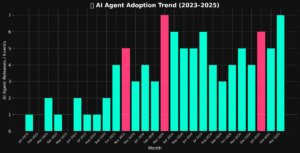
📊 AI Agent Adoption Curve (2023–2025)
This chart visualizes the rapid rise of AI agent launches since 2023, with key spikes during OpenAI Dev Day, Devin’s debut, and CES 2025.
💼 What It Means for Workers & Businesses
🌟 Opportunities
- AI-enhanced productivity: Agents handle grunt work
- New job types: Agent trainers, workflow designers
- Startup gold rush: Agent-as-a-Service platforms
⚠️ Challenges
- Job disruption in admin/dev/ops roles
- Trust & auditing: Verifying agent actions
- Security risks with autonomous execution
🧠 Infographic Idea: “How AI Agents Work”
Visual Workflow: User sets goal → Agent plans → Uses APIs/tools → Executes → Self-checks → Finishes
Icons for APIs, scheduling, coding, docs. Dark background with neon blue arrows.
🔮 What’s Next for AI Agents?
- Multi-agent ecosystems: Teams of agents working together
- OpenAgent marketplaces: Buy/sell agent modules
- Agent plug-ins in platforms like Notion and Zapier
- AI agent regulation to ensure safety and auditability
“The agent layer is becoming as important as the app layer.” — Andreessen Horowitz AI Report 2025
✅ Takeaways & Next Steps
AI agents are evolving fast—and smart teams are already experimenting. Don’t wait.
Test, adapt, and automate.
Explore AI Agents in the Tools Directory →
Subscribe for Weekly AI Briefings →