🔍 Introduction
OpenAI’s GPT-4.1 has just landed—and while everyone’s talking about its 1 million-token context window, there’s a deeper story hiding beneath the surface.
From enabling truly autonomous coding agents to reshaping how businesses manage knowledge at scale, GPT-4.1 may quietly be the real bridge to AGI. In this exclusive GateOfAI breakdown, we decode what makes GPT-4.1 the most transformational release yet—beyond the headlines.
🧩 What Makes GPT-4.1 Different (That No One Is Talking About)
- Agent-native capabilities: Full toolchains and conversations persist in memory, enabling goal-based reasoning across hundreds of steps.
- Zero-shot reasoning power: Improved ability to generate task-specific workflows without examples.
- Real-time document agents: Models can now reason over full documents like legal cases, codebases, or medical reports.
🧠 Real-World Use Cases
- Codebase copilots: Developers feed entire repos to GPT-4.1 for refactoring and scaffolding.
- Legal assistants: Lawyers process full case histories instantly for insight generation.
- Data journalists: GPT-4.1 handles mass datasets and reports for insight discovery.
📊 Comparative Overview: GPT-4 vs GPT-4.1
| Feature | GPT-4 | GPT-4.1 |
|---|---|---|
| Token Limit | 128K | 1 Million |
| Agent Memory Support | Basic | Full-session memory |
| Multimodal Input | Limited image | Image + extended documents |
| Best Use Case | General chat | AI agents, legal analysis, coding pipelines |
📈 Visual Representation
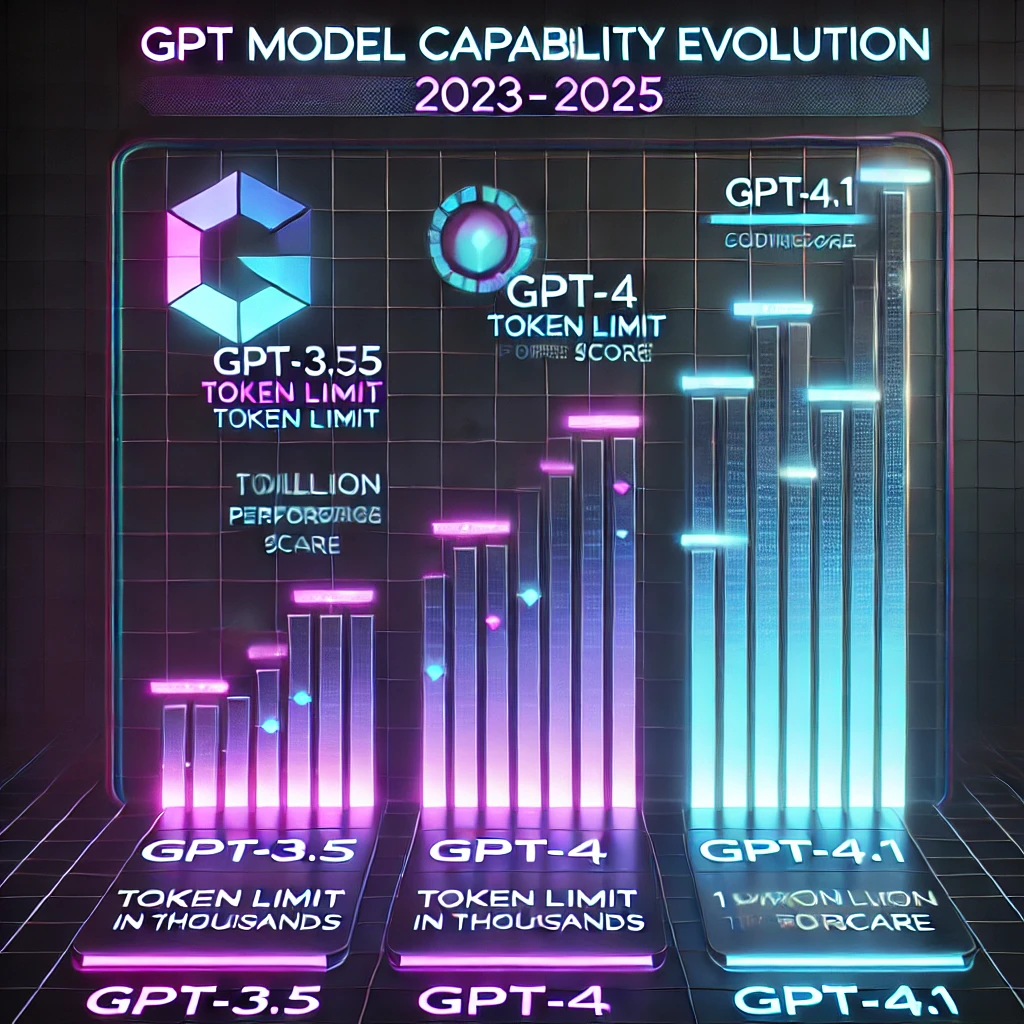
This chart compares token window size and coding performance across GPT-3.5, GPT-4, and GPT-4.1.
🎯 GateOfAI Take: Why This Really Matters
GPT-4.1 isn’t just technically better—it’s philosophically different. It behaves more like a persistent collaborator than a chatbot.
- Fully autonomous agents now possible
- Memory spans entire workflows
- Multi-domain synthesis (code + law + research) in real time
In short: GPT-4.1 is what GPT-4 promised to be. And what GPT-5 might perfect.