2026-04-22
© Gate of AI
A new Gallup study reveals a significant shift in Gen Z’s attitude towards AI: While adoption remains steady, excitement is plummeting as workplace fears and learning concerns take center stage.
Key Takeaways
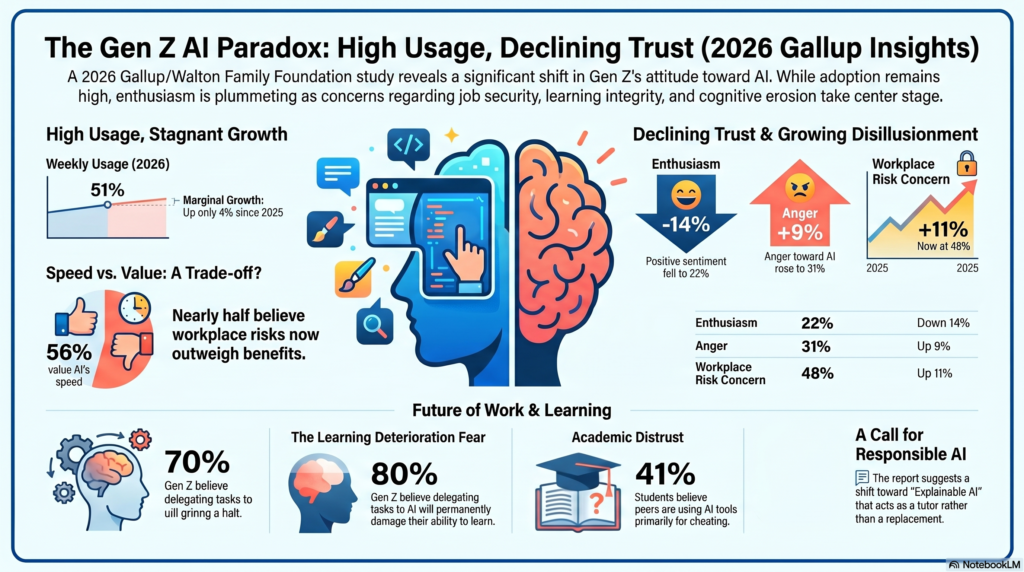
- Generative AI adoption has stagnated; 51% of Gen Z uses it weekly, an increase of only 4% from 2025.
- Positive sentiment is crashing: Excitement dropped by 14 points (to 22%), while “anger” toward AI surged to 31%.
- 48% of Gen Z workers now believe the risks of AI in the workforce outweigh the benefits.
- 80% of Gen Z fears that relying on AI to speed up tasks will permanently hinder their ability to learn.
What Happened
A comprehensive new study titled “Voices of Gen Z” has uncovered a growing disillusionment among young adults regarding artificial intelligence. Conducted by Gallup in partnership with the Walton Family Foundation and GSV Ventures, the data released in April 2026 indicates that the generation once viewed as the ultimate early adopters is now sounding the alarm on AI’s societal trajectory.
The findings point to an “AI Paradox”: While the majority of Gen Zers (51%) still use generative AI technology weekly, their trust in it is rapidly deteriorating. In just one year, excitement and hopefulness dropped by 14 and 9 percentage points respectively. Simultaneously, 31% of Gen Z now report feeling outright “anger” toward the technology, up from 22% last year, and anxiety remains highly elevated at 42%.
This shift is heavily attributed to the “Workplace Risk Gap.” Even though 56% of Gen Z acknowledges that AI helps them complete tasks faster, nearly half (48%) of Gen Z workers now believe the risks of AI in the workforce vastly outweigh its benefits—a striking 11-point increase in skepticism over the prior year. They fear that AI is no longer just a tool for efficiency, but a looming threat to job security and human authenticity.
The Numbers
| Metric | Details | Source |
|---|---|---|
| 📅 Date Published | April 9, 2026 | Gallup / Walton Family Foundation |
| 📊 Weekly AI Adoption | 51% of Gen Z (stagnant from 2025) | Gallup |
| 📉 Sentiment Shift | Excitement fell to 22%; Anger rose to 31% | Gallup |
| ⚠️ Workplace Fear | 48% say AI risks outweigh benefits | Gallup |
| 🎓 Learning Impact | 80% believe AI will make learning more difficult | Gallup |
Why This Matters Now
The timing of this study is pivotal for the tech industry. It directly contradicts the historical assumption that younger generations will naturally embrace and champion new technologies. Historically, older demographics express skepticism while youth adopt; however, with AI, the heaviest users are demonstrating the deepest reservations about its long-term corrosion of society.
For companies like OpenAI, Anthropic, and Google—who are currently investing billions into enterprise and educational AI tools (like ChatGPT Edu)—these insights are a glaring warning sign. If Gen Z’s rejection of AI transitions from sentiment to behavioral boycott, it could result in a massive slowdown in consumer AI adoption. The industry stands at a crossroads where ignoring these ethical and cognitive concerns could irreparably damage consumer trust.
Technical Breakdown & Academic Friction
The friction isn’t just about job displacement; it is deeply rooted in cognitive development and academic integrity. One of the most striking technical findings of the Gallup study is the perceived cost of automation. While AI can undeniably optimize workflows and generate rapid outputs, 80% of Gen Zers believe that offloading cognitive tasks to AI will fundamentally degrade their ability to learn and think critically.
Furthermore, the technology is creating an atmosphere of peer distrust in educational environments. Even as schools race to implement AI guardrails—with 74% of K-12 students noting their schools now have official AI policies—roughly 41% of students believe their classmates are using AI to cheat. This highlights a fundamental flaw in current AI integration: the technology is functioning as an invisible crutch rather than a transparent educational aid.
What Comes Next
The implications of this study demand an immediate pivot from tech companies and educational institutions. As Stephanie Marken, senior partner at Gallup, noted, “Gen Z isn’t rejecting AI outright, but they are reassessing its role in their lives.”
In the short term, developers must transition their focus from sheer processing speed to “Explainable AI” (XAI) and cognitive augmentation. Instead of building tools that simply “do the work for you,” the next wave of successful AI must act as a collaborative tutor that transparently guides the user without eroding their critical thinking skills. Schools and workplaces must also focus on transparent, thoughtful integration rather than outright bans or unchecked usage.
Our Take
At Gate of AI, we view the Gallup findings not as a rejection of innovation, but as a mature, necessary course correction by Gen Z. This generation is heavily connected, but they are refusing to be blindly compliant. They are correctly identifying that speed does not equal progress if it comes at the cost of human intellect and economic security.
The tech industry must treat this data as a mandate to evolve. Building faster LLMs is no longer enough; the mandate for 2026 and beyond is building responsible AI that empowers human capital rather than replacing it. It’s time to listen, adapt, and build tools that respect the user’s desire for authenticity and cognitive growth.
