© Gate of AI
The era of the “prompt” is officially over. OpenAI has unveiled GPT-5.5, a paradigm-shifting update that transforms ChatGPT from a passive conversational assistant into an autonomous digital worker capable of executing complex, multi-step enterprise workflows.
Key Takeaways
- True Agentic Autonomy: GPT-5.5 can break down complex problems, natively operate external software tools, audit its own work, and iterate autonomously until a task is fully resolved.
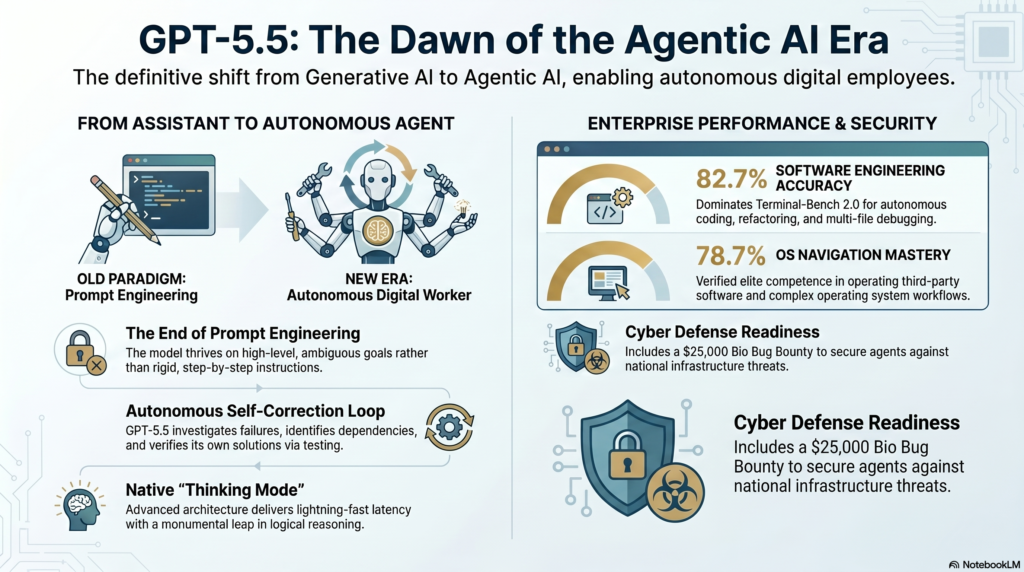
- The End of Micromanagement: The model navigates ambiguity with unprecedented human-like logic, drastically reducing the need for rigid “prompt engineering” and step-by-step guidance.
- Engineering Dominance: With an 82.7% accuracy rate on Terminal-Bench 2.0, GPT-5.5 establishes itself as the ultimate AI coding agent for enterprise software development and debugging.
- The “Super App” Evolution: This launch signals OpenAI’s aggressive expansion toward a unified AI workspace, seamlessly blending conversational AI, autonomous web browsing, and code execution into one centralized hub.
What Happened: The Dawn of GPT-5.5
On April 23, 2026, OpenAI officially released GPT-5.5 and its enterprise-grade counterpart, GPT-5.5 Pro. Described by OpenAI leadership as a “new class of intelligence,” this highly anticipated launch marks the tech giant’s definitive pivot from Generative AI to Agentic AI.
For the past three years, large language models (LLMs) have required humans to act as operators—feeding inputs and copying outputs. GPT-5.5 shatters this limitation. It is engineered to operate as an active, goal-oriented system capable of planning, acting, and adapting in real time. Natively designed to interact with computer interfaces, browse the live web, and analyze massive enterprise datasets, GPT-5.5 bridges the gap between digital reasoning and digital execution.
Furthermore, the model addresses historical AI bottlenecks by introducing an advanced “Thinking Mode.” This architecture allows the AI to produce highly structured, logically sound outputs with exceptional token efficiency—matching the lightning-fast latency of GPT-5.4 while delivering a monumental leap in cognitive processing.
The Numbers That Matter
| Metric / Benchmark | Performance Details | Enterprise Significance |
|---|---|---|
| 💻 Terminal-Bench 2.0 | 82.7% Accuracy | Unprecedented capability in autonomous software engineering, legacy code refactoring, and multi-file debugging. |
| 🌐 OSWorld-Verified | 78.7% Accuracy | Proves elite competence in navigating complex operating systems and executing third-party software workflows independently. |
| ⚡ Latency & ROI | Matches GPT-5.4 Speeds | Delivers massive capability upgrades while remaining highly cost-efficient and utilizing significantly fewer tokens per task. |
| 🛡️ Cyber Security Focus | $25,000 Bio Bug Bounty | Showcases aggressive, proactive red-teaming to secure autonomous agents against severe biological and cybersecurity threats. |
Why This Matters Now: The Enterprise Demand
The AI industry has reached a critical saturation point with standard conversational chatbots. Today’s enterprises are no longer impressed by an AI that can merely draft a polite email. They demand systems that can draft the email, update the CRM, and generate the associated financial report simultaneously—without human intervention.
OpenAI’s release of GPT-5.5 is a calculated, aggressive response to rising market pressures from Anthropic’s Claude 4.7 and Google’s Gemini 3.1 Pro. By integrating deep agentic capabilities directly into the ChatGPT ecosystem, OpenAI is actively fighting to maintain its position as the default operating system for global knowledge workers. This release cements a vital industry narrative: 2026 is officially the year AI transitions from a passive oracle to an active digital employee.
Technical Breakdown: The Death of Micromanagement
The defining architectural triumph of GPT-5.5 is its conceptual clarity and autonomous self-correction loop. Older models required exhausting “prompt engineering,” forcing users to meticulously micromanage every variable of a request. GPT-5.5, conversely, thrives on messy, high-level, and ambiguous instructions.
Consider a modern software engineering team. If they encounter a catastrophic failure in a sprawling codebase, GPT-5.5 doesn’t just suggest a localized fix. The agent investigates why the code failed, maps exactly where the patch belongs, identifies affected dependencies across the entire architecture, writes the executable code, and verifies the solution via autonomous testing. It holds the broader shape of the system in its context window, navigating complex failures without freezing or hallucinating.
What Comes Next: The Workforce Disruption
As GPT-5.5 rolls out globally to Plus, Pro, Business, and Enterprise tiers, the fundamental definition of “computer work” is about to be violently disrupted. We anticipate an immediate surge in hyper-productive “one-person unicorn companies” and massive structural shifts in corporate workflows, as executives realize they can delegate entire project lifecycles rather than isolated tasks.
Simultaneously, OpenAI’s introduction of the “Trusted Access for Cyber” program signals a darker, more complex future. They are preparing the groundwork for an era where autonomous AI agents defend critical national infrastructure against equally autonomous AI threat actors. The global cybersecurity landscape is about to be rewritten by machine-speed warfare.
Our Take
At Gate of AI, we view GPT-5.5 not as an incremental software update, but as a critical inflection point in human-computer interaction. Just days after the UAE announced its historic mandate to transition 50% of its government to Agentic AI, OpenAI has conveniently provided the exact caliber of commercial engine required to make such ambitious global visions a reality.
However, the true test of GPT-5.5 will not be its impressive benchmark scores, but its reliability in the wild. If this model truly eliminates the need for human micromanagement, it will inevitably force a global reckoning regarding the economic value of entry-level knowledge work. The race is no longer about building the smartest AI; it is about building the most capable digital worker. And with the launch of GPT-5.5, OpenAI has firmly taken the lead.
