Published on: June 8, 2026 | By: Mohammad Saed (Technical Architect & Founder)
At a Glance
| Architect | Mohammad Saed |
| Architectural Focus | Local-First Deterministic Architecture (Cost Optimization) |
| Best For | Tech founders, system developers, and SaaS companies scaling production AI applications |
| Financial Impact | Slashes production API overhead expenditure by up to 75% |
| Reviewed Block | System Framework Design Optimization Loops |
The 2026 Reality: The High Cost of Heavy Abstraction Frameworks
Most tech founders and developers scale their AI applications under a costly assumption: that soaring API invoices from providers like OpenAI, Google, or Anthropic are simply an unavoidable “tax” on growth. They accept bleeding margins as the baseline cost of doing business. It isn’t. It is a fundamental system design failure.
Watch Practical Tutorial
The High-Level Framework Trap
When you architect agentic workflows using heavy, high-level framework libraries, they promise magic by managing state, memory variables, and multi-turn loops implicitly behind black-box abstractions. While excellent for spinning up local proof-of-concepts, this opaque design layer creates severe financial vulnerabilities in parallel production environments:
Core Infrastructure Vulnerabilities
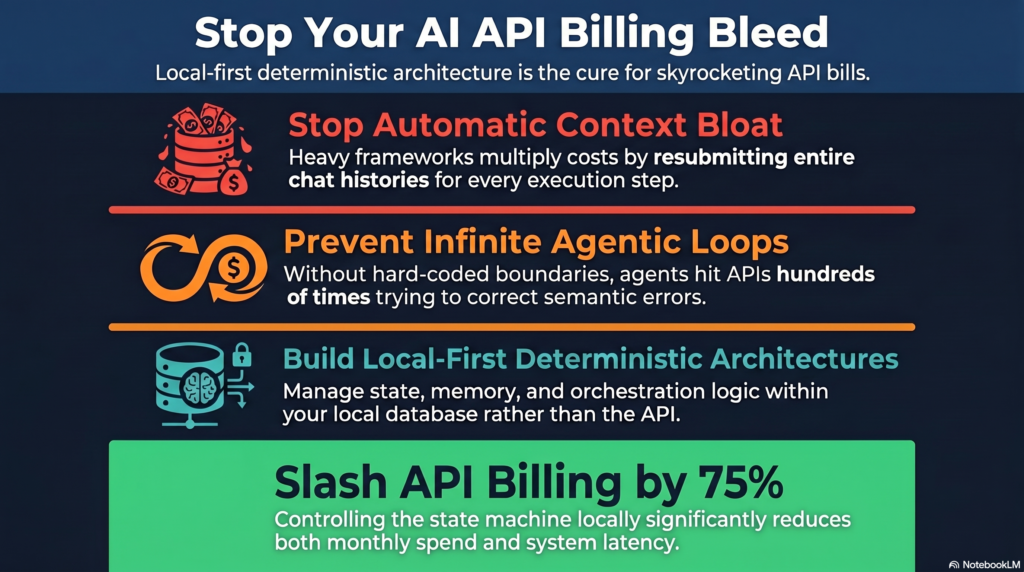
- The Context Bloat Trap: To maintain conversation and context boundaries across sequential tasks, these heavy libraries blindly resubmit the entire historical chat ledger and dense system prompts on every single sub-step execution. Because frontier API pricing models are asymmetric—billing recursively for input tokens—your context volume expands exponentially. Your infra budget is quickly consumed by processing static, unchanged history rather than generating new operational data.
- The Infinite Agentic Loop: Without strict, code-level orchestration gates, a reasoning agent can easily get trapped in a semantic error-correction loop. When hitting an unparsed schema deviation or an unexpected API payload, the model repeatedly pings the external endpoint to determine “what tool to execute next.” Lacking deterministic exit loops, it can execute hundreds of rapid-fire queries within seconds, creating a vertical spike on your billing dashboard before telemetry flags the thread.

The Solution: Local-First Deterministic Architecture
Slashing your production API overhead does not mean your engineering team must pivot to hosting massive, slow open-weight models on expensive, self-hosted GPU infrastructure. The true remedy lies in decoupling system state from model execution loops, treating external frontier model layers exclusively as stateless, ephemeral calculators.
Real-World Execution Failure
Scenario Test: An application workflow graph runs completely autonomous path planning across multi-turn recursive user sessions without boundaries.
Actual Outcome: When an unmapped payload format drops into the orchestration loop, the unmonitored agent attempts self-correction recursively, initiating dozens of immediate calls to external frontier models and blowing out the API credit lines before billing limits trigger an application shutdown.
Pricing — Is It Worth It?
Don’t let third-party abstraction packages dictate your operational margins. Build clean pipelines, control your token window limits, and own your infrastructure layers securely. Spending computing capital on bloated layers is entirely avoidable with proper software design.
Verdict
Rating: 75% Cost Reduction Potential
At Gate of AI, our continuous enterprise technical optimization audits substantiate a clear rule: slashing production AI expenditures is not a machine learning training problem—it is a robust system design problem. When engineering leads wrest deployment control back from bloated abstraction dependencies and maintain the core state-machine locally, operational API expenses drop by up to 75% while application runtime latency shrinks dramatically.
✅ Pros
- Isolating your state array inside local cache elements halts redundant backend payload weight.
- Filtering arrays via server utilities flattens out structural input token curves cleanly.
- Hardcoded backend routes completely insulate pipelines from infinite loop spikes.
❌ Cons
- Demands explicit code-level development instead of relying on rapid boilerplate drop-ins.
- Requires precise handling of tiktoken dependencies directly inside active backend stacks.
- Requires continuous profiling of multi-agent state parameters across database instances.