Advanced Workflow Automation with TypeScript and the OpenAI Agents SDK

Share:
Tutorial
Advanced
⏱ 45 min read
© Gate of AI 2026-04-16

Master agentic orchestration using TypeScript and the latest OpenAI Agents SDK to automate high-reasoning software development workflows.

🎥

Watch Practical Tutorial

Prerequisites

  • Node.js v20.0 or higher (LTS recommended)
  • OpenAI Tier 4+ API Access (for GPT-5 reasoning models)
  • Advanced TypeScript knowledge and Node.js environment setup
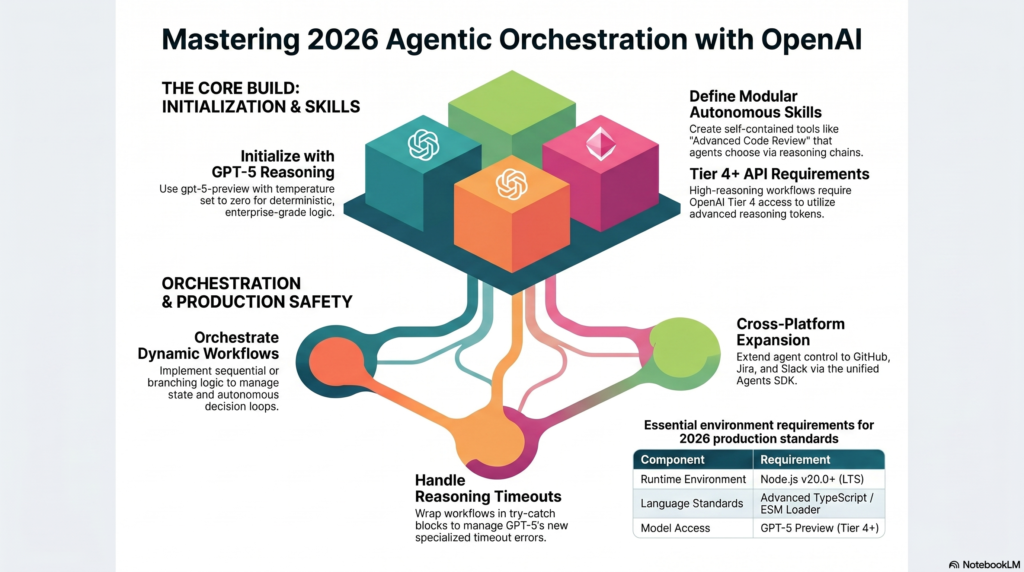
What We’re Building

In this 2026 guide, we are moving beyond simple API calls. We will build a Multi-Skill Agentic Workflow. Unlike standard LLM implementations, this system utilizes the 2026 OpenAI Agents SDK to manage state, execute specialized “Skills,” and handle autonomous decision-making loops.

This project demonstrates how to reduce manual CI/CD intervention by allowing AI agents to conduct deep code analysis and verification checks with near-zero latency.

Setup and Installation

Ensure you are using the latest version of the SDK, which supports native 2026 reasoning models.

npm install @openai/agents-sdk@latest typescript ts-node dotenv

Configure your environment for 2026 production standards:


# .env file
OPENAI_API_KEY=your-openai-api-key
OPENAI_ORG_ID=your-org-id
  

Step 1: Initializing the Agent with GPT-5

We will initialize the agent using gpt-5-preview, which supports the enhanced reasoning tokens required for complex workflow orchestration.


import { Agent } from '@openai/agents-sdk';
import dotenv from 'dotenv';

dotenv.config();

const agent = new Agent({
  apiKey: process.env.OPENAI_API_KEY,
  model: 'gpt-5-preview', // Utilizing 2026 Frontier reasoning
  temperature: 0, // Critical for consistent workflow automation
});

agent.initialize().then(() => {
  console.log('Agentic Core initialized successfully');
}).catch(error => {
  console.error('Core Initialization Failure:', error);
});
  

In this updated setup, we use temperature: 0 to ensure that the agent follows the deterministic logic required for enterprise-grade automation.

Step 2: Defining Autonomous Skills

Skills in the 2026 SDK are modular tools that the agent can “choose” to execute based on its reasoning chain.


import { Skill } from '@openai/agents-sdk';

const codeReviewSkill = new Skill({
  name: 'advancedCodeReview',
  description: 'Performs deep architectural analysis and security auditing.',
  execute: async (context) => {
    console.log('Agent is analyzing architectural patterns...');
    // In a real-world scenario, you would integrate with a linter or compiler here
    return { 
      status: 'verified', 
      logicCheck: true, 
      timestamp: new Date().toISOString() 
    };
  }
});

agent.registerSkill(codeReviewSkill);
  

Step 3: Orchestrating the Agentic Workflow

Workflows now support dynamic step branching. We’ll start with a foundational sequential execution.


import { Workflow } from '@openai/agents-sdk';

const deploymentWorkflow = new Workflow({
  name: 'prodDeploymentCheck',
  steps: [
    { 
      skill: codeReviewSkill, 
      input: { repository: 'main-branch-v5' } 
    }
  ]
});

agent.runWorkflow(deploymentWorkflow).then(result => {
  console.log('Agent successfully completed workflow:', result);
}).catch(error => {
  console.error('Workflow interrupted:', error);
});
  
🚀 Pro Tip: For 2026 production environments, always wrap your runWorkflow in an async/await block inside a try-catch to handle the new “Reasoning Timeout” errors introduced in GPT-5.

Testing Your Agent

node --loader ts-node/esm index.ts

Using the ESM loader ensures compatibility with the latest version of the Agents SDK. You should see the agent initialize, analyze the “codebase,” and return a verified status.

Expanding Your Agent’s Intelligence

  • Muse Spark Integration: Bridge your SDK to Meta’s Muse Spark for multi-modal code review (visual UI/UX analysis).
  • Real-time Dashboards: Hook the agent.on('step') event into a WebSocket to watch your AI work in real-time.
  • Cross-Platform Orchestration: Use the same SDK to control agents across GitHub, Jira, and Slack.
Share:

Was this tutorial helpful?

What are you looking for?