Agentic AI: Transforming Enterprises by 2026
Editorial & Technical Analysis
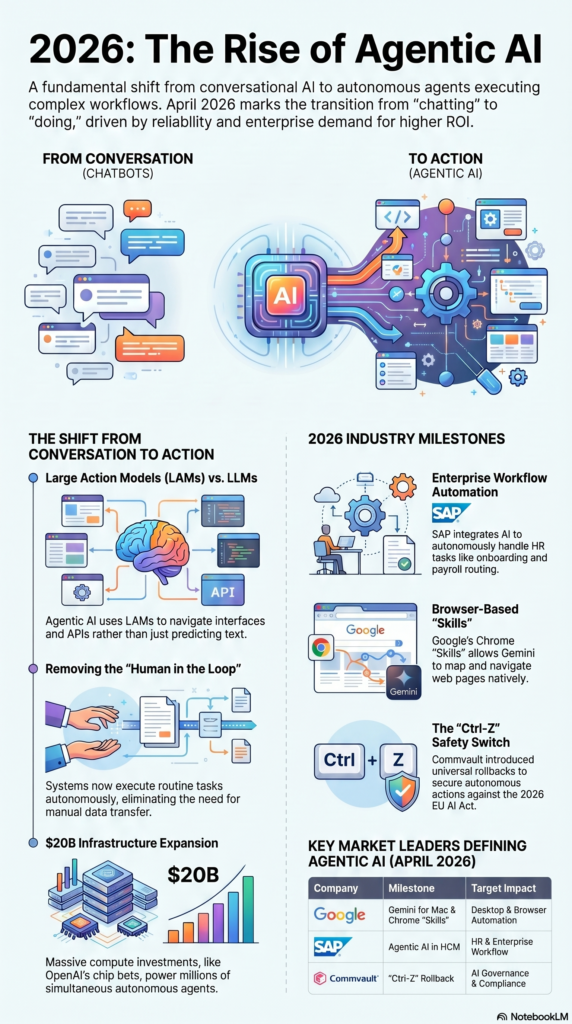
With SAP integrating agentic models into HR, Google launching Gemini desktop agents, and Commvault introducing safeguards for autonomous cloud workloads, April 2026 marks the turning point where AI moved from “chatting” to “doing.”
Watch Practical Tutorial
What Happened
For the past three years, the tech world was obsessed with text generation and conversational interfaces. However, the announcements cascading through April 2026 have signaled a definitive shift. The new frontier is no longer about talking to AI; it is about deploying Agentic AI—systems that can autonomously plan, navigate interfaces, and execute tasks across multiple applications.
On the consumer and developer front, Google made waves this week by launching Gemini for Mac with Live Voice Mode and introducing “Skills” in Chrome. This essentially turns the browser into a capable desktop agent that can remember user workflows and execute them on command. Meanwhile, Meta teased its “Muse Spark” project, aiming to scale local models toward personal superintelligence.
But the most significant shifts occurred in the enterprise sector. SAP announced a massive rollout of agentic AI within its Human Capital Management software, allowing AI to autonomously handle onboarding, payroll routing, and compliance checks. Anticipating the risks of letting AI run wild on corporate servers, Commvault launched a revolutionary “Ctrl-Z” feature for cloud AI workloads, giving IT administrators a universal rollback switch for autonomous actions.
The Numbers
Ready to apply enterprise AI inside your own operations?
Turn AI breakthroughs into custom internal workflows, inventory trackers, and client portals without heavy engineering overhead.
Why This Matters Now
The transition to agentic AI matters now because it fundamentally alters the return on investment (ROI) equation for businesses. Generative AI required heavy human oversight—a “human in the loop” to read, verify, and copy-paste outputs. Agentic AI aims to remove the loop entirely for routine tasks.
We are seeing this rapid adoption because the underlying foundational models have finally reached a state of high reliability and lower hallucination rates. Furthermore, the economic pressure on enterprises to maximize their cloud computing and software budgets has driven companies like Microsoft, Google, and SAP to offer features that actively do the work, rather than just acting as a brainstorming partner.
Technical Breakdown
The engine behind this shift relies on Large Action Models (LAMs) and tool-use frameworks. Unlike standard LLMs that predict the next token of text, these agentic models are trained on graphical user interfaces (GUIs) and API endpoints. They understand how to click buttons, fill out forms, and pass data between disparate software silos.
Google’s new Chrome “Skills,” for example, leverages DOM (Document Object Model) mapping to let Gemini navigate web pages natively alongside the user. In the enterprise, SAP’s implementation uses rigorous guardrails, translating natural language requests into strict API calls that interact directly with the backend databases, bypassing the need for a front-end interface altogether.
To support this massive computational load, infrastructure is also evolving. Just this week, rumors surfaced of OpenAI’s massive $20 billion bet on specialized AI chips from Cerebras Systems, highlighting the sheer scale of compute required to run millions of autonomous agents simultaneously.
What Comes Next
As agents move from sandboxed environments to live corporate networks, governance and compliance will become the dominant narrative for the remainder of 2026. The EU AI Act is heavily scrutinizing autonomous systems, demanding rigorous audit trails for decisions made by AI.
This is exactly why products like Commvault’s “Ctrl-Z” are hitting the market. We can expect an explosion of “AI security” startups that don’t just secure data, but secure actions—monitoring agents at runtime to prevent unauthorized database modifications, accidental mass-emails, or privilege escalation.
Our Take
The era of the “chat box” is ending. If 2024 was the year of AI exploration and 2025 was the year of integration, 2026 is undoubtedly the year of execution.
While the prospect of autonomous software agents routing corporate finances or managing IT infrastructure is terrifying to some, the productivity gains are too immense to ignore. The companies that will win this decade are not those building the smartest conversational models, but those building the safest and most reliable frameworks for AI to take action. The race for the ultimate AI agent has truly begun.
Explore Live AI Calculators, Leaderboards & Side-by-Side Comparisons
LLM API Cost Calculator
Accurately estimate token consumption and operational costs across 50+ frontier LLMs including GPT-4o, Claude 3.5, Gemini, and DeepSeek.
AI Model Leaderboard
Evaluate frontier AI models side-by-side: reasoning benchmarks, code generation accuracy, latency scores, and price-to-performance rankings.
AI Comparison Matrix
Explore head-to-head architectural comparisons, pricing structures, feature breakdowns, and verified alternatives across leading AI software.
Ready-to-Deploy Production Solutions & SaaS
Dev Prompt Engine & Agent Architect
Bespoke workbench for system prompts, Claude XML tags, LangGraph/CrewAI schemas, and MCP servers with 0% BYOK.
SkillForge AI – AI-Powered Learning Management System
An AI-powered learning platform for discovering courses, generating learning content, managing students and instructors, and delivering a complete…
AI SaaS Website Analyzer Tool
Instantly analyze any website URL and get detailed AI-powered insights, website quality assessments, SEO analysis, and actionable recommendations.