Intermediate
⏱ 8 min read
© Gate of AI
Reverse engineer the open-sourced X recommendation algorithm to write high-converting hooks and maximize your content’s organic reach.
The Content Ecosystem Strategy
To build a sustainable content architecture, your website should always be the ultimate source of truth, while social platforms like YouTube and X serve as marketing funnels. This tutorial breaks down the technical secrets of the X algorithm so you can drive massive traffic back to your core platforms.
Reverse Engineering the X Algorithm
Following the recent open-source release of the X “For You” feed algorithm, developers and content creators finally have programmatic proof of what actually drives engagement. It is no longer just about likes and retweets; the core of the ranking system relies on behavioral metrics that track exactly how users interact with your text on screen.
In this guide, we will analyze the exact parameters found in the xAI repository to understand how to craft the perfect “Hook” and guarantee maximum visibility.
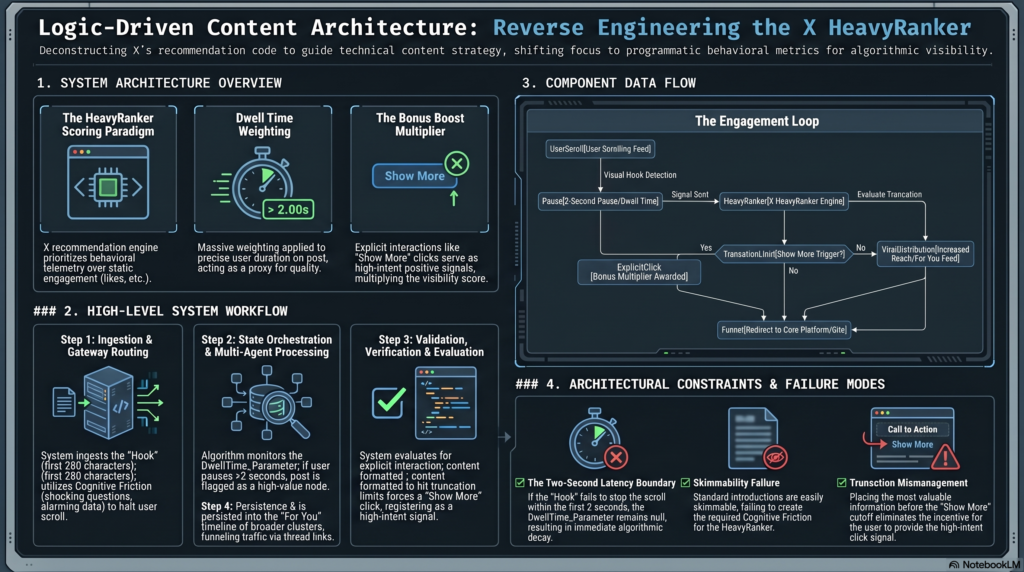
1. The Technical Secret: The “Dwell Time” Parameter
Deep within the open-source code, there is a massive weighting applied to a metric known as Dwell Time. The X algorithm actively tracks the exact amount of time a user spends reading your tweet before they scroll past it.
If your post causes a user to pause their scrolling, the algorithm immediately flags your content as “high-value.” The longer they stay on the text, the higher your algorithmic score spikes. This means your primary goal as a writer is not just to deliver information, but to visually and psychologically stop the scroll within the first two seconds.
2. The Formula for a Programmatic Hook
Based on the code’s preference for high Dwell Time, standard introductions fail because they are easily skimmable. To force the algorithm to rank your tweet higher, your hook must create instant cognitive friction.
The most effective hooks utilize two specific triggers:
- The Shocking Question: Frame your opening as a question that challenges an industry standard. (e.g., “Is the era of proprietary AI models completely dead?”)
- The Terrifying Metric: Start with an alarming or massive data point that forces the brain to process the number. (e.g., “90% of developers are using outdated attention mechanisms. Here is why.”)
These structures force the reader to pause and process the information, directly feeding the Dwell Time parameter the data it needs to boost your post.
3. The “Show More” Bonus Multiplier
One of the most actionable discoveries in the codebase is the Bonus Boost awarded for explicit interaction. While likes and bookmarks are valuable, the algorithm highly rewards content that prompts the user to click the “Show More” text expansion button.
From a programmatic standpoint, clicking “Show More” is registered as an explicit, high-intent positive engagement. To leverage this:
- Format your tweets to be intentionally long enough to trigger the truncation limit.
- Place your most compelling hook or a cliffhanger exactly where the text cuts off, making the user physically click to read the rest of the tutorial or find the link to your site.
// Conceptual representation of X’s HeavyRanker feature scoring
function calculateTweetScore(tweet) {
let baseScore = tweet.likes * 0.5 + tweet.retweets * 1.0;
// The Dwell Time Multiplier (Logarithmic scaling)
if (tweet.dwellTimeSeconds > 2) {
baseScore += Math.log(tweet.dwellTimeSeconds) * 2.5;
}
// Explicit Intent Action: The "Show More" Expansion
if (tweet.isTextExpanded) {
baseScore *= 1.4; // 40% algorithmic boost multiplier
}
return baseScore;
}
Have a question about this tutorial?
Our AI assistant has read this tutorial and is ready to answer all your questions instantly. Open the chat for step-by-step guidance!
